
There’s no shortage of advice about where small businesses should spend their marketing dollars. Advertise on Google. Invest in social media. Upgrade your software. Try the latest AI tool.
Much of that advice has merit, but it often overlooks the financial reality of running a small business. Telling you to spend more on ads makes sense if you’re the platform. It lands differently when you’re a solopreneur or a small nonprofit on a tight budget.
And the costs aren’t just financial. Every new platform or tool costs you time and attention, and most small business owners are short on both.
So how do you decide what’s worth paying for when your small business marketing budget is limited?
Build your marketing foundation before paying for more attention
With small businesses, I usually start with a website, search visibility (how easily people find you on Google), and organic social media (your regular, unpaid posts). That’s how people find you, figure out what you offer, and start to trust you.
That doesn’t mean everything has to be perfect before you consider advertising. But if you’re paying to send people to a website that doesn’t clearly explain your services or make it easy to contact you, you’re spending money to expose a problem you could have addressed first.
I’m taking this approach with CGL Marketing, too. I haven’t started with paid advertising. I’ve put my time into my website, search visibility, and posting consistently. Like a lot of small business owners, I’m fitting it in around everything else.
Paid advertising absolutely has its place. Awareness campaigns can introduce you to a new audience, and search ads make sense when people are already looking for what you do. Decide based on what you need to accomplish, not on whether you have money to spend.
When spending more doesn’t solve the problem
Consider a small business spending $250 a month on Google Search ads. For some, that’s easy to absorb. For others, it’s a significant commitment that needs to produce results fast.
When a campaign isn’t generating enough traffic or leads, the recommendation is often to increase the budget. More spend only helps if there’s enough demand and the campaign is reaching the right people.
Take a small nonprofit serving a limited geographic area. Even with a Google Ad Grant (free ad credit Google gives eligible nonprofits), it may struggle to generate meaningful traffic if few people are searching for its programs or activities. Neighborhood groups, community partnerships, or email might reach more of the right people.
The growing cost of marketing tools
Advertising is only one part of the budget. Then there are the subscriptions you pile up just to run your marketing.
Website services, email platforms, design software, scheduling tools, and AI subscriptions can each seem fine on their own. But the monthly fees add up, especially when tools overlap, or the feature you need is on the next tier up.
One community nonprofit I work with was looking at nearly $1,000 a year for accounting software, which was a huge chunk of a small budget. That’s not a marketing expense, but it shows how quickly subscriptions can weigh on a small organization.
AI and marketing tools are creating the same pressure. They promise to save time, so it’s tempting to sign up for several, each doing something slightly different. And then there are the marketing consultants using AI to promise weeks or months of social media content in minutes.
AI can produce an impressive volume of posts. But producing content isn’t the same as having a content strategy. If those posts don’t sound like you, connect with your customers, or serve a purpose, what did you gain? Saving time is valuable, but not if you’re sacrificing what makes your business different.
Getting more value from your small business marketing budget
Organic marketing is often described as free, but it isn’t. Maintaining a website, creating content, and staying active on social media all take time, whether you do it yourself or pay someone to help.
Facebook’s recent restrictions on external links for some accounts show how quickly organic marketing can get harder. If you’ve relied on social posts to send people to your website, you may need to find another way.
This is why I think your website should stay the home base of your marketing. It’s the one place you control.
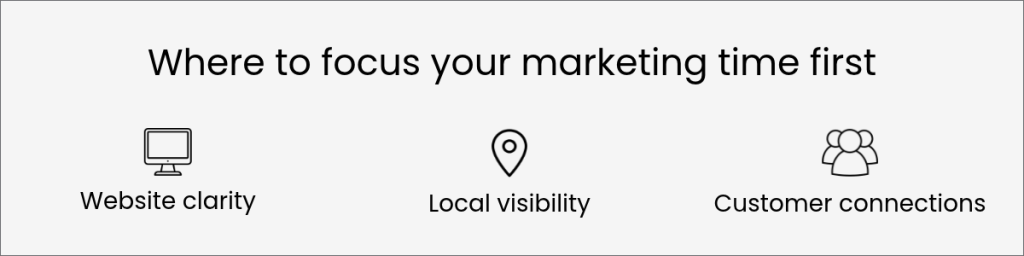
If I had five hours this month, I’d start with the basics. First, make sure your website says what you do and how to reach you. A stranger should be able to tell within a few seconds. Second, if you serve a local area, complete your Google Business Profile (the free listing that shows up on Google Maps and local searches). Third, I’d look at how you stay connected with existing customers, whether that’s email, social media, or something else. Once those basics are in place, consider whether ads make sense for your goals.
Spend with purpose before you add another thing
It’s easy to feel like keeping up means doing more of everything. A bigger budget or a longer to-do list doesn’t automatically get you better results.
Before you commit to another subscription, ad campaign, or activity: decide what result you expect, how you’ll know within 60 to 90 days, and when you’ll stop if it isn’t working.
Sometimes spending more is the right decision. Other times, the better investment is improving something you already have or deciding there’s something you don’t need to do at all.
Want to Learn More?
Here are a few helpful posts if you’re ready to go a little deeper:
- Marketing Overwhelm Is Real: Here’s What to Focus on First
- What Types of Small Businesses Benefit Most from Google Ads
- The 5 Most Important Places Your Small Business Should Be Online
Be Distinct • Build Awareness • Grow Your Small Business.
About Carla Gerardu-Low
Small Business Marketing Consultant
I’m a small business marketing consultant based in Oakland, CA, helping small business owners and nonprofits build a clearer, more focused approach to their marketing.
Through CGL Marketing, I provide marketing strategy and ongoing support to help clients prioritize what matters, create aligned content, and build visibility in a way that’s practical and sustainable.
If that sounds like the kind of marketing support you’re looking for, I’d love to hear from you. Let’s chat.